Was the December
26, 2004 Indonesian Earthquake and Tsunami
Caused by a Stellar Explosion 45,000 Light Years Away?
Sound Crazy? Read Carefully Below.
(Originally posted
February 20, 2005)
Gamma Ray Bursts,
Gravity Waves, and Earthquakes
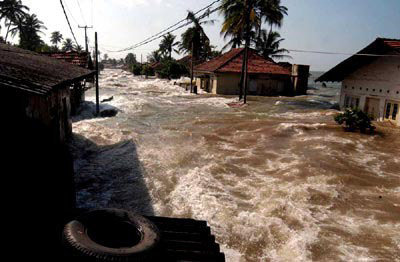
On December 26,
2004 a magnitude 9.3
earthquake occurred in the Indian Ocean off the coast of
Sumatra in Malaysia. It caused a powerful tsunami which
devastated coastal regions of many countries leaving over 240,000
people either dead or missing. It was the worst tsunami
to affect this area since the 1883 explosion of Krakatao. The
earthquake that produced it was so strong that it exceeded by
a factor of 10 the next most powerful earthquake to occur anywhere
in the past 25 years.
• Indonesian 9.3 Richter earthquake:
December 26, 2004 at 00
hours 58 minutes
(Universal Time)
It is then with some alarm that we learn
that just 44.6 hours later gamma ray telescopes orbiting
the Earth picked up the arrival of the brightest gamma ray burst
ever recorded!
• Gamma ray burst arrival:
December 27, 2004 at 21
hours 36 minutes
(Universal Time)
This gamma ray
blast was 100 times more intense than any burst that had been
previously recorded, equaling the brightness of the full Moon,
but radiating most of its energy at gamma ray wavelengths. Gamma
ray counts spiked to a maximum in 1.5 seconds and then declined
over a 5 minute period with 7.57 second pulsations. The
blast temporarily changed the shape the Earth’s ionosphere, distorting
the transmission of long-wavelength radio signals. See
stories on Space.com,
BBC
News, NY
TImes.
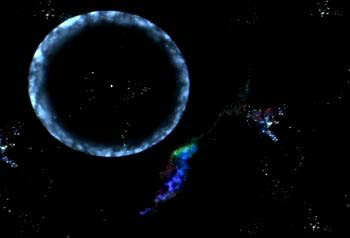
Artists conception, courtesy of NASA
It was
determined that the burst originated from the soft gamma ray
repeater star, SGR 1806-20, a neutron star 20 kilometers in diameter
which rotates once every 7.5 seconds, matching the GRB pulsation
period. SGR 1806-20 is located about 10 degrees northeast
of the Galactic center and about 20,000 to 32,000 light years
from us, or about as far away as the Galactic center. (Originally,
it had been thought to be 45,000 light years from us. but new
results place it closer.) The outburst released more energy
in a tenth of a second than the Sun emits in 100,000 years. Other
gamma ray bursts have been detected whose explosions were intrinsically
more powerful than this one at the source of the explosion, but
since those explosions originated in other galaxies tens of thousands
of times more distant, the bursts were not nearly as bright when
they reached our solar system. What makes the December
27th gamma ray burst unique is that it is the first time that
a burst this bright has been observed, one that also happens
to originate from within our own Galaxy.
Astronomers
have theorized that gamma ray bursts might travel in association
with gravity wave bursts. In the course of their flight
through space, gamma rays would be deflected by gravitational
fields and would be scattered by dust and cosmic ray particles
they encountered, so they would be expected to travel slightly
slower than their associated gravity wave burst which would pass
through space unimpeded. After a 45,000 year light-speed
journey, a gamma ray burst arrival delay of 44.6 hours would
not be unexpected. It amounts to a delay of just one part
in 9 million. So if the gravity wave traveled at the speed
of light (c), the gamma ray burst would have averaged a speed
of 0.99999989 c, just 0.11 millionths slower. There is
also the possibility that at the beginning of its journey the
gravity wave may have had a superluminal speed; see textbox below.
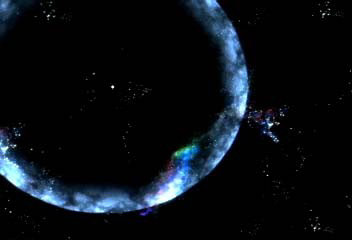
Artist’s conception, courtesy of NASA
The 9.3
Richter earthquake was ten times stronger than any other earthquake
during the past 25 years, and was followed just 44.6 hours
later on December 27th by a very intense gamma ray burst,
which was 100 fold brighter than any other in the past 25 year
history of gamma ray observation. It seems difficult to pass
off the temporal proximity of these two Class I events as being
just a matter of coincidence. A time period of 25 years
compared to a time separation of 44.6 hours amounts to a time
ratio of about 5000:1. For two such unique events to have
such a close time proximity is highly improbable if they
are not somehow related. But, as mentioned above, gravity
waves would very likely be associated with gamma ray bursts,
and they would be expected to precede them.
Many have inquired
if there might be a connection between these two events (e.g.,
see the Space.com
article). Not thinking of the gravity wave connection,
astronomers have been reluctant to admit there might be a connection
since they know of no mechanism by which gamma rays by themselves
could trigger earthquakes. They admit that the December
27th gamma ray burst had slightly affected the ionization state
of the Earth’s atmosphere, but this by itself should not have
caused earthquakes. However, if a longitudinal gravity
potential wave pulse were to accompany a gamma ray burst, the
mystery becomes resolved. The connection between earthquakes
and gamma ray bursts now becomes plausible.
In his
1983 Ph.D. dissertation,
Paul LaViolette called attention to terrestrial dangers of Galactic
core explosions, pointing out that the arrival of the cosmic
ray superwave they produced would be signaled by a high intensity
gamma ray burst which would also generate EMP effects (e.g.,
see Page 3).
He also noted that a strong gravity wave might be expected to
travel forward at the forefront of this superwave and might be
the first indication of a superwave’s arrival. He pointed
out that such gravity waves could induce substantial tidal forces
on the Earth during their passage which could induce earthquakes
and cause polar axis torquing effects.
[Please note, the gravity potential gradient
associated with a stellar explosion or core explosion would drop
off in intensity inversely with distance traveled (according
to 1/r), and would not drop off as the inverse cube of distance
as some have claimed on the internet. That is, it does
not have a force-distance dependence similar to the lunar tidal
force. So the impact would be quite significant. The
mathematics are worked out in the above reference.]
In his book Earth
Under Fire (as well as in his dissertation), LaViolette
presents evidence showing that the superwave that passed through
the solar system around 14,200 years ago had triggered supernova
explosions as it swept through the Galaxy. Among these
were the Vela and Crab supernova explosions whose explosion dates
align with this superwave event horizon. He points out
that these explosions could be explained if a gravity wave accompanied
this superwave, it could have produced tidal forces which could
have triggered unstable stars to explode as it passed through.
He wrote at a
time when gamma ray bursts had just begun to be discovered, and
when no one was concerned with them as potential terrestrial
hazards. In recent years scientific opinion has come around
to adopt LaViolette’s concern, as can be seen in news articles
discussing the SGR 1806-20 gamma ray outburst, e.g., see Space.com
news story. They note that if this gamma ray burst
had been as close as 10 light years it would have completely
destroyed the ozone layer. By comparison, the Galactic
superwaves LaViolette has postulated to have been generated as
a result of an outburst of our Galaxy’s core and to have impacted
the Solar system during the last ice age would have impacted
the solar system with a cosmic ray electron volley having an
energy intensity 100 times greater than this hypothetical 10
light year distant stellar gamma ray burst. In
comparision, SGR 1806-20 has been estimated to have a stellar
progenitor mass of 150 solar masses, whereas our Galactic core
has a mass of 2.6 million solar masses. In its present
active phase, SGR 1806-20 is estimated to have a luminosity 40
million times that of the Sun, whereas during its active phase
the Galactic center could reach luminosities of 400 trillion
times that of the Sun. So it is understandable that
if the Galactic center were to erupt, it would produce a gamma
ray burst and a gravity wave far more intense than the outburst
from this star.
If anything,
the December 27, 2004 gamma ray burst shows us that we do not
live in a peaceful celestial environment. And if the December
26th earthquake was in fact part of this same celestial event,
we see that this stellar eruption has claimed many lives. For
this reason, it is important that we prepare for the possibility
of even stronger events in the future, the arrival of superwaves
issuing from the core of our Galaxy. Like the December
26th earthquake and the December 27th gamma ray burst, the next
superwave will arrive unexpectedly. It will take us by
surprise.
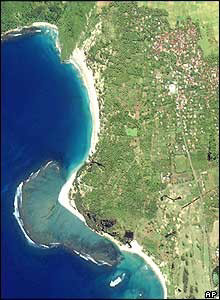 
It would
have been possible to determine whether a Galactic gravity wave
had indeed immediately preceded the December 26th earthquake
by examining data from gravity wave telescopes. Since seismic
waves from the Indonesian earthquake would have taken some time
to propagate through the Earth to these gravity wave antenna,
their signature could be distinguished from the gravity wave
coming from SGR 1806-20. However, the major gravity wave
telescopes were unfortunately not on line at that time. LIGO (Laser
Interferometer Gravity Wave Observatory), which consists of two
correlated telescopes, one in Washington state and one in Louisiana,
each having a four kilometer long laser interferometer beam path,
was in the process of being made operational and unfortunately
was not collecting data at that time. We sent an
email to the staff of the TAMA gravity wave antenna in Japan.
Dr. Takahashi, who is responsible for the detector, replied
that their telescope was unfortunately not operating during that
week since they were making modifications at that time. So
at present the gravity wave hypothesis remains neither confirmed
nor disproven.
The December 27th GRB was not accompanied
by any rise in the cosmic ray background, indicating that if
it was accompanied by cosmic rays their intensity was unable
to exceed the relatively constant extragalactic background flux
arriving from distant galaxies. A Galactic superwave, on
the other hand, would most likely produce a substantial rise
in these levels.
Note that almost two
months passed before the December 27th gamma ray burst found
its way into news media stories. If unusually intense activity
were to occur in the near future as the beginning stages of a
superwave arrival, it is hoped that scientists will not keep
this knowledge to themselves but rather allow the global news
media to disseminate the story quickly to inform the world.
A Superluminal Gravity Wave?
Experiments carried out by Eugene Podkletnov
show that a shock front outburst produces a longitudinal gravitational
wave that travels forward with the burst. He has found
that this gravity wave pulse has a speed in excess of 64 times
the speed of light (personal communication). Also Guy Obolensky
has produced spark discharge electric potential shock fronts
and observed them to propagate forward at speeds as high as 10
times the speed of light. Observations suggest that the
gravity wave from an expanding stellar explosion will decrease
its superluminal speed and eventually approach the speed of light
as the shock front expands. But meanwhile, the gravity
wave will have obtained a headstart over the electromagnetic
wave radiation component traveling in its wake (light waves,
gamma rays, etc.). So one would expect that the gravity
wave from such an outburst (and its resultant earthquake activity)
would precede the gamma ray burst component.
|
Others Coming to the Same
Conclusion
Dr. LaViolette posted the above
page on February 20, 2005 having learned about the December 2004
gamma ray burst on the day before and at that time realized that
it must have been associated with the Malaysian tsunami. On
February 21st Lazarus Long also posted a similar idea on a news
group.
Lazarus Long
Posted: Feb 21 2005-21:23
I just thought I should put this on this thread for the record.
A very interesting event occurred almost simultaneously with
the Tsunami event but it appears few have noticed but this gamma
ray burst almost coincided with the tectonic event (it was slightly
afterward) here on Earth. I am curious if what we witnessed was
a gravitational bow wave effect that preceded the actual gamma
radiation as a shock-wave. Just coincidence?
Could be but….
Remember the distance traveled was 50,000 lt yrs. This could
be evidence to verify the critical aspects of quantum gravitational
theory as a mountain of data was collected. My suspicion is that
a type of Huygens Gravitational Wave effect may have preceded
the actual EM *flash* by many hours or it might simply reflect
the period of compression and gravitational displacement within
the Neutron Stars’ power surge that preceded the actual EM emission.
Apparently the entire solar system was shaking from the event,
in fact the entire galaxy is apparently experiencing a kind of
gravitational oscillation (vibration) as this wave propagates.
What if we are seeing an event that can be quantified to be slightly
faster than light and being propagated just ahead of it?
While the flash was noticed after the tectonic event locally
it is entirely conceivable that the actual gravitation shock
wave struck earlier and while no one to date has related the
two events I am curious if we may also be seeing evidence of
how cosmic scale events could interfere with planetary tectonics
by introducing a trigger force sufficient to release the pent
up energy that already exists internally within the planet.
I am curious if the relationship of gravity and the event
can be measured precisely in relation to the actual EM radiation
emitted that we may have sufficient data and measures to test
quantum gravitational theory against, which are analogous to
how the Michaelson Morley experiment was used to verify Relativity
Theory.
|
Click here
for a list of books by Paul LaViolette
Click
here for downloadable papers by Paul LaViolette
|
